Showing posts with label Fiji. Show all posts

Saturday, January 30, 2016

Humanitarian Work in the Islands Continued . . .

As promised, here is a brief report on the other wonderful missionary couples we work with.  The couple called to Vanuatu is from Germany.  They arrived on the island nation of Vanuatu on Monday, March 9, 2015.  Just four days later, Cyclone Pam hit the islands of Tanna and Efate on Friday, March 13th with 180 mph winds.  Our couple have been up to their eyebrows with the recovery on the two islands receiving the most damage.  Many people question why it is taking so long to rebuild.  The answer:  This is a complicated, large dollar project.  The humanitarian project provides materials and training for those who's homes/shelters were damaged so they will be able to rebuild a stronger, safer family shelter.  Some of the homes are totally gone.  Those people will receive basic training and material to help rebuild a safer structure.  Others will get supplies to make repairs.  Teaching people to "help themselves" and become self-reliant is a big part of the project.  Our couple has been visiting and making assessments of all the homes that are in need of repair.  This has been done on both islands.  There are no street addresses, so a local person has to go with them to help locate the people and do the assessments.  It has been an arduous task.  The assessments are now complete and technical specialists have helped to streamline the project with a few changes here and there.  Several "model" shelters have been built and it looks like things are starting to move forward.  Needless to say, they have not had a lot of time to think of anything but the Cyclone Pam rebuild.


We actually have two couples doing humanitarian work in Fiji, a missionary cople from Switzerland and couple from Calgary, Canada.  When we were there in August we visited a village which wanted help improving their community hall.  This community building was also use to hold church meetings.  A humanitarian project was approved and the before and after pictures tell the story.  Local people did the work themselves.


In Samoa we had a couple from Redlands, California.  They helped to provide clean water to many communities.  They were also instrumental in distributing used school furniture shipped from New Zealand to needy schools in Samoa.  They also helped build a walkway so children could more safely cross a stream to get to school.  This couple finished their mission the end of January.  Our new missionary couple replacing them are currently on the job.  They are from Las Vegas, Nevada and have just arrived in Samoa after a few days of training in New Zealand.


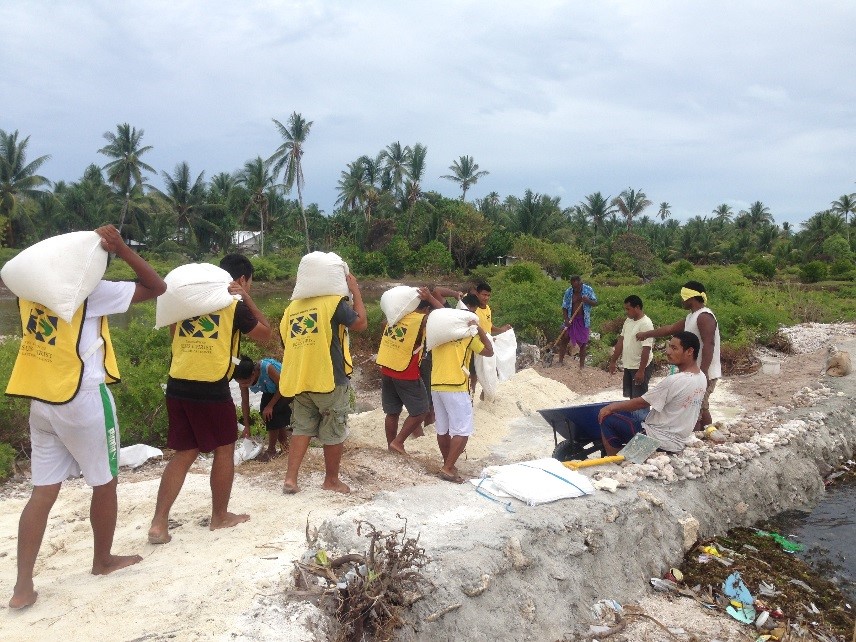
On the tiny island nation of Kiribati (Tarawa) we have a couple from Kaysville, Utah.  Since Tarawa is a very flat atoll (a coral island) there is always a problem with flooding.  This missionary couple have helped several villages build seawalls to protect village families from flooding; a constant threat.


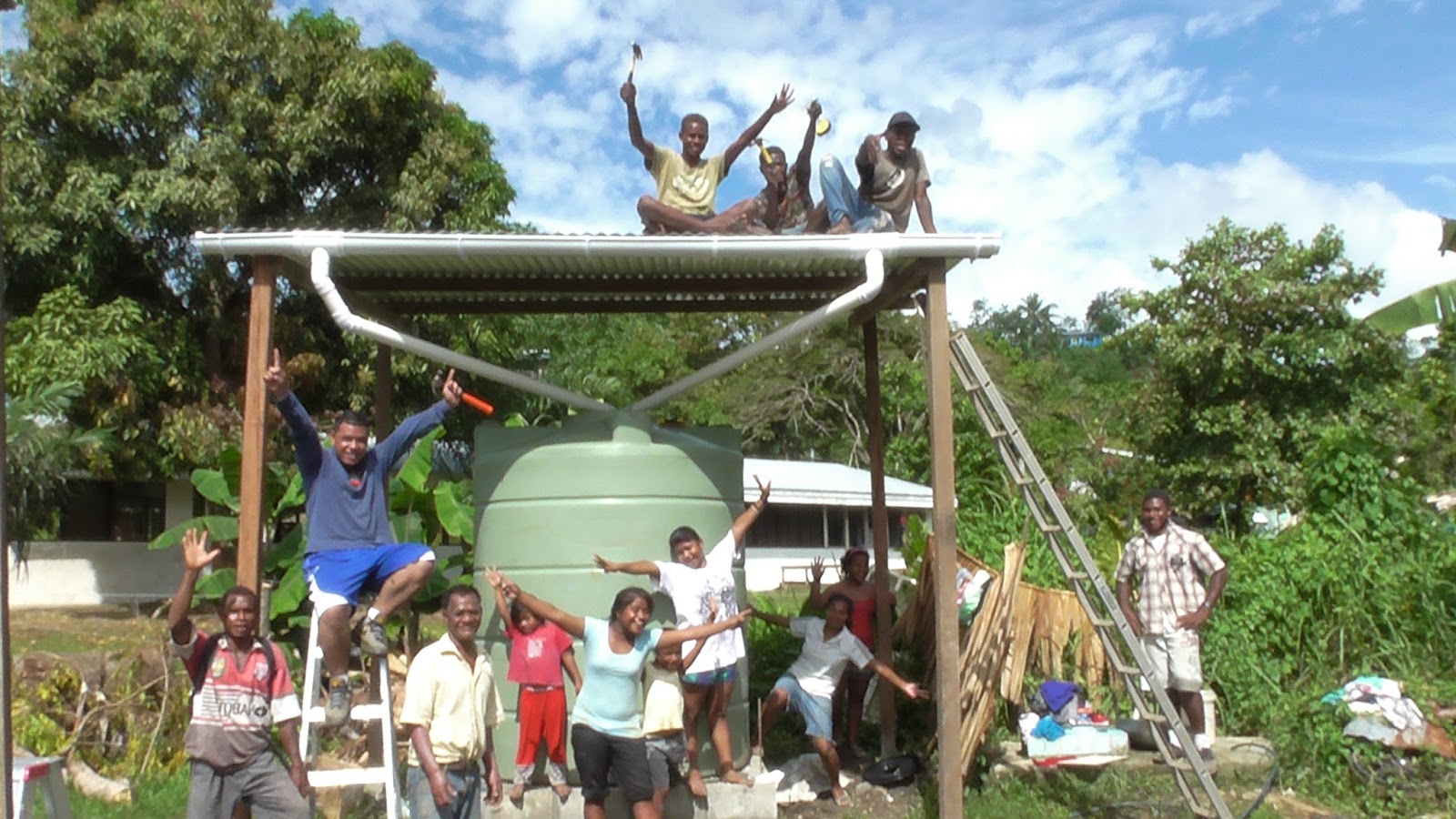
In the Solomon Islands, our couple does double duty as self-reliance and humanitarian missionaries.  They have been helping people to secure and install rain-water catchment tanks as well as helping teach dental hygiene and assisting the young women to assemble maternity packs for new mothers.  They were also able to help provide local schools some needed badly needed sports equipment.


In addition, we also have two couples who operate the Church humanitarian dental clinics on the islands of Tonga and Samoa.  They are retired dentists who have been called to serve for 18 to 23 months managing the dental clinics and helping improve community dental hygiene.  Their wives help in the clinics as well as with community training.  The couple in Tonga is from West Viriginia and the couple in Samoa are from Calgary, Canada.  The clinics are on the campus of the Church run schools and the services are free.  Originally the clinics were started so that the young missionaries turning in their mission application papers would get a "real" checkup prior to their mission.  The dental services are on a first-come, first-served basis and serve the entire community of both Church members and friends of other faiths.  Their objective is to improve dental health and to help the local dental community increase their skills and expand their services. 


"When called to (serve), we should focus our efforts on being what we are called to be, not on what we feel qualified to do."  Dallas H. Oaks. "Life's Lessons Learned"

Sunday, January 10, 2016

Humanaitarian Work in the Islands

Our main missionary responsibility is to support other missionary couples who serve as humanitarian missionaries and county welfare managers on the islands of Tonga, Samoa, Fiji, Solomon Islands, Marshall Islands, Kiribati, and Vanuatu.

We feel we have some of the finest couples to work with.  They truly work hard at their callings and each have done a marvellous job.


Our couple in Tonga are from Inkom, Idaho.  They are doing marvelous work in teaching young children that a key to preventing diabetes is to exercise and choose the right foods.  They a created contest between the schools as a method of teaching diabetes prevention. There were 12 schools invited to participate.  The children competed by performing skits, songs or write essays and poems on the theme of "choose the right".   To emphasise the message, each student received a CTR ring to wear as a daily reminder.


Their efforts are part of the church’s continuing initiative to support Pacific Island Ministries of Health and Education in their fight against diabetes.


In Fiji we have a wonderful couple from Switzerland.  They have taught the people on the island of Tavenuni how to garden.  They went a step further than just giving them seeds and teaching them how to plant and care for their crops.  They also taught them how to gather seeds, preserve them and plant again the next year.  This has been a very successful project and the people are able to feed their families as well as have a little extra to sell at the market.


Our couple in the Marshall Islands are laying the groundwork for a framework of diabetes prevention.  Together with a local wellness center run by Canvasback.org, a Seventh-day Adventist organization, they have weekly clinics where they measure blood sugar, teach cooking and exercise.  They are educating the people about diabetes detection, treatment and prevention.  They are also teaching them how to garden in containers or small spaces. 


We will make another post soon and tell you about the couples on the islands of Kiribati, Samoa, Vanuatu, and Solomon Islands.

"A child who sees his father and mother forgo comforts for themselves as they reach out to those in distress, will likely follow the same pattern when he or she grows to maturity.   Gordon B Hinckley, Stand a Little Taller.

Friday, May 22, 2015

Tarawa, Kiribati

On Wednesday we left Auckland, New Zealand and flew to Nadi, Fiji.  This was a layover to catch the weekly plane to Tarawa, Kiribati. 
At the New Zealand airport
We originally were going to fly out early Thursday morning. However, upon returning to our room after dinner we packed our bags and set our alarms for the early morning flight and received a phone call saying that the morning flight had been cancelled.  Our flight now was scheduled for a 1:50 pm departure. Of course this required us to scramble to get in touch with our people in Kiribati to let them know of the delay.  Phone connections in the islands are not always reliable.  

The next morning instead of getting up at 4 am, we slept in, had breakfast, and caught the shuttle to the airport.  We arrived at the airport the requested 3 hours early and settled in for a long wait.  The monitor now showed the flight leaving at 2:25 pm.  The plane finally took off at 2:45 pm and arrived in Tarawa at 5:45 pm.  After finding our bags and going through customs(?) we walked out to see Elder Waldron waiting for us.  We asked about his self-reliance class that he was suppose to teach at 6:00 pm and he said we should be able to make it.  We drove to the chapel where he taught a class on the Perpetual Education Fund and we sat in to help.


There is only one road on Tarawa, Kiribati.  It is approximately 30 km (18 miles) long  and 800 meters wide (1/2 mile). Only a small portion of the road is paved.  The rest is a "very bumpy" ride.  Elder Waldron taught his class and we spoke to another class who were learning about starting small  businesses.
Elder Waldron teaching class
Because we arrived so late we were not able to meet with all the appointments that Elder and Sister Waldron had set up for Thursday, therefore we went to our hotel and checked in about 9 pm. 


Friday morning we started our meetings early.  We met several people regarding recently flooded villages.  We drove to the village of Ambo and met with the village leaders in their maneaba (community meeting center).  Ambo village, which recently experienced tidal flooding is willing to do all the work to build a new seawall, if the Church will help them with sandbags and cement. They would like to build the sea wall before the next high tide if possible.


Maneaba (community meeting center)


Susan, Gary, Sister an Elder Waldron
Water has come up inside the village 
After our meeting with the people in Ambo we drove to our meeting with the Ministry of Health (MOH).  We were actually late for this meeting as we had spent longer than planned in Ambo.  Everyone had left, except one specialist who we met with regarding the diabetes problem on Kiribati. We plan to work with the MOH on reducing diabetes on Kiribati.


After our meeting with the MOH we drove to Moroni High School (a church run school) and met with the school principal who provided some good information on the island's needs.  


That was the last of our meetings for the day.  We returned to the hotel where we had dinner with the Waldrons and made plans for Saturday.  We will be here till Monday.  Stay tuned! 

"Humanitarian acts "rooted in a desire to listen, to heal, to cooperate, to respect" are as potent agents for change as anything on the earth."  Sharon Eubank, Director of Humanitarian Services, May 14, 2015.